研究组李嘉鑫博士后、邓联贵副教授等与武汉大学郑国兴教授合作,联合撰写的研究论文”Towards Generalized Dynamic Metasurface Holography with Learned Real-Momentum-Locked Evolution”被美国化学会国际知名学术期刊 ACS Nano 正式接收(IF=17.2, JCR Q1)
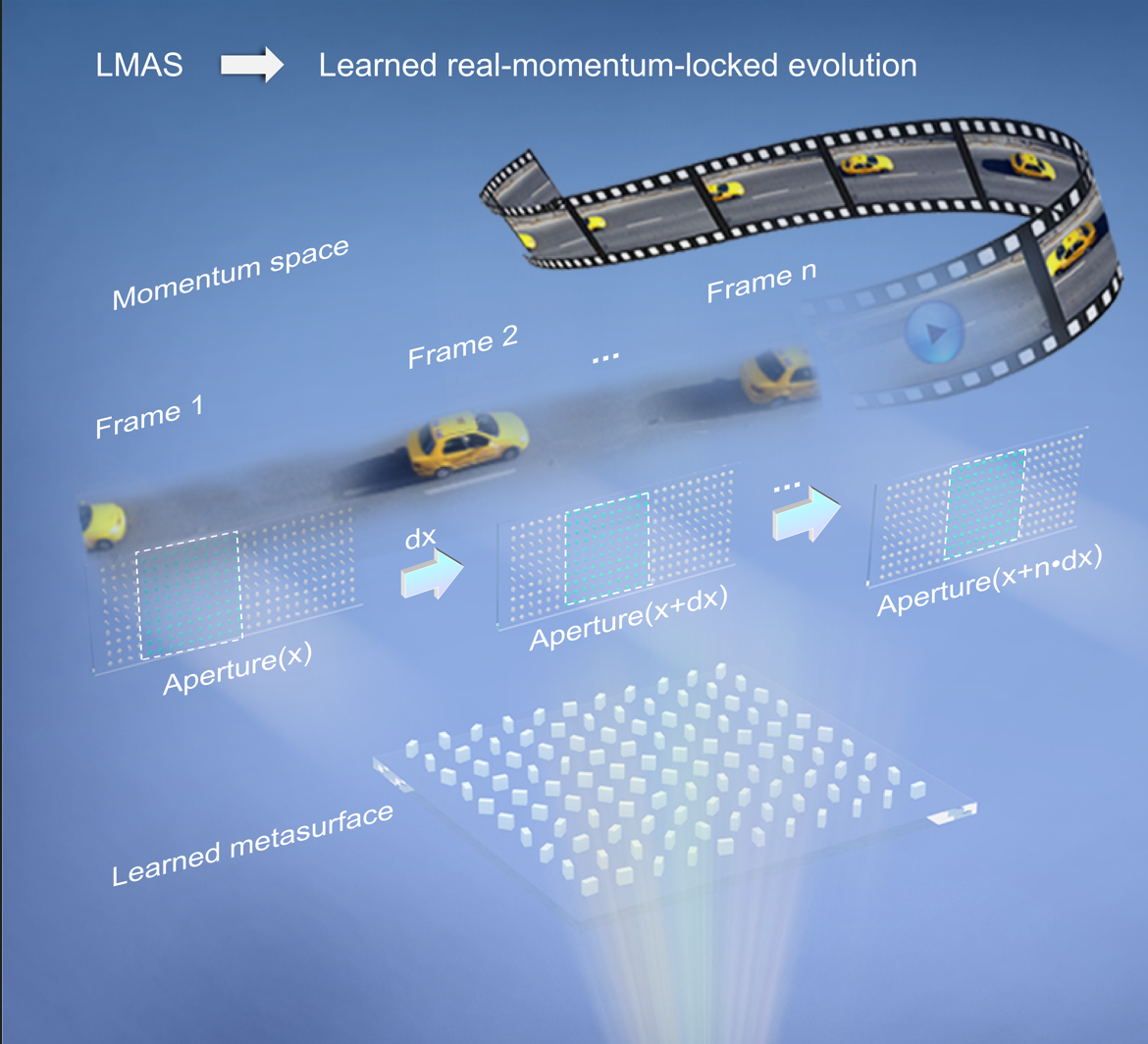
动态全息是下一代显示技术的重要发展方向,在增强现实、虚拟现实等领域具有重要应用前景。尽管超表面已成为实现动态全息的有力技术手段,但现有研究仍主要局限于光强调控,限制了可用于显示和信息存储的光学通道。针对这一问题,本研究提出了一种基于学习型超表面与孔径合成(Learned Metasurface and Aperture Synthesis,LMAS)的新框架,构建了适用于单色、彩色、三维及矢量等主要动态全息类型的通用平台。该方法将傅里叶对偶性从固有的静态实空间—动量空间映射关系拓展至动态调控范畴,通过梯度优化建立了实空间孔径位移与动量空间全息光场演化之间的可学习映射关系。尤为重要的是,孔径本身不依赖于特定光场属性的固有特性,为不同光学自由度的统一调控提供了通用物理接口,从而实现了四种不同类型动态超表面全息的实验演示。该研究将超表面发展为一种面向全息光场动态演化的通用化、紧凑化且具有良好可扩展性的技术架构,能够以极简的系统配置实现多维动态全息调控,为先进显示、光学存储及信息复用等领域提供了广阔的应用前景。
原文摘要如下:Dynamic holography is pivotal for next-generation displays with critical applications in augmented reality, virtual reality, and beyond. While metasurfaces have emerged as powerful approaches for dynamic holography, existing works remain largely confined to intensity-only modulation, restricting the available channels for display and information storage. Herein, we realize a generalized platform applicable to major types of dynamic holography (monochromatic, color, 3D, and vectorial) by introducing a learned metasurface and aperture synthesis framework (LMAS). This paradigm extends Fourier duality from the intrinsic static real-momentum mapping relationship into the dynamical regime, and establishes a learned mapping between real-space aperture displacement and momentum-space holographic evolution via gradient optimization. Crucially, the aperture’s inherent field-agnostic nature provides a universal physical interface that unifies diverse optical degrees of freedom, allowing us to demonstrate four distinct types of dynamic meta-holography. The LMAS approach establishes metasurface as a generalized, compact, and scalable architecture for holographic evolution within a minimalist system configuration, offering broad potential in advanced displays, optical storage, and information multiplexing.